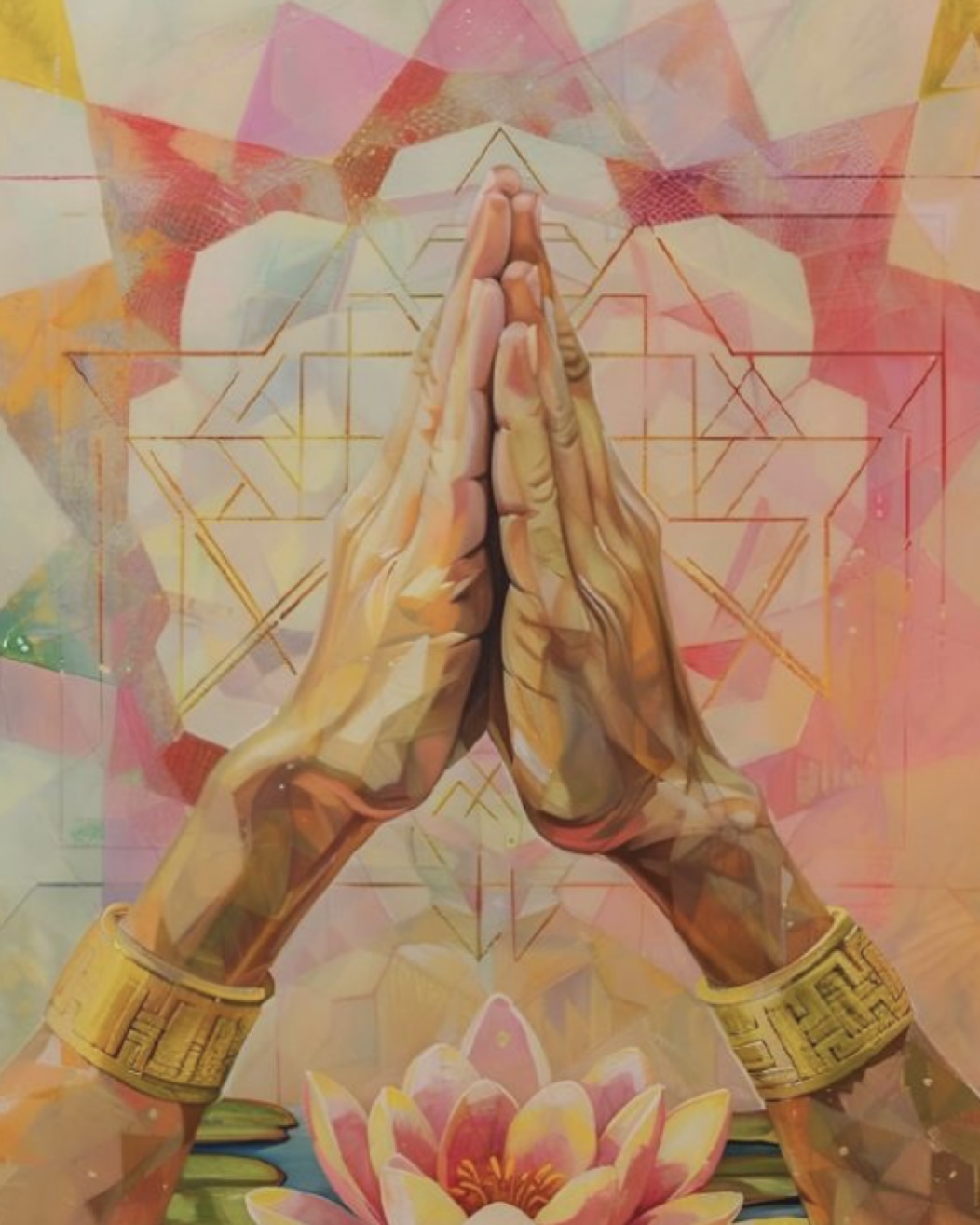
Before I became a yoga teacher, I studied art history. My favorite art movement has always been Art Nouveau—those sinuous, organic curves that mimic nature's patterns. What I didn't realize then was that I was drawn to the same thing that underlies yoga: sacred geometry, the mathematics of beauty, the repeating patterns that structure everything from galaxies to seashells to the shapes we make with our bodies on the mat.
Sacred geometry is the study of geometric patterns and proportions that appear throughout nature, art, and spiritual traditions across cultures. These aren't arbitrary shapes—they're fundamental organizing principles of the universe. And they show up, again and again, in asana practice.
This isn't coincidence. It's recognition: the same patterns that organize the cosmos organize our bodies. When we practice yoga, we're literally embodying the architecture of existence.
The Golden Ratio: Nature's Perfect Proportion
The golden ratio (phi, approximately 1.618) is perhaps the most famous example of sacred geometry. It's a proportion found everywhere: in nautilus shells, pinecones, flower petals, the spiral of galaxies, the proportions of the human body, and masterworks of art and architecture from the Parthenon to Renaissance paintings.
The golden ratio describes a specific relationship where a line is divided so that the whole line (A+B) relates to the longer segment (A) in the same way that the longer segment (A) relates to the shorter segment (B). Mathematically: (A+B)/A = A/B = 1.618...
This might sound abstract until you see it. The golden ratio creates spirals that feel inherently pleasing, balanced, harmonious. Leonardo da Vinci used it obsessively. So did the ancient Greeks. So does nature.
The Golden Ratio in Your Body
Your body embodies golden ratio proportions:
- The ratio of your total height to your navel height
- The ratio of your shoulder to fingertips compared to your elbow to fingertips
- The segments of your fingers
- The spiral of your ear
Now think about vrksasana (tree pose). When we stand on one leg with the other foot pressed to the inner thigh and arms overhead, we're creating a vertical line that emphasizes these proportions. The body becomes a study in balanced asymmetry, in stability through apparent imbalance. We're not just "doing a pose"—we're embodying a mathematical principle that exists throughout the natural world.
The tree outside your window grows according to the same ratio. So does the pose named for it.
Triangles: Strength Through Three Points
The triangle is the strongest geometric shape structurally. It can't be distorted without changing the length of its sides. This is why architects use triangular trusses in bridges and buildings.
In yoga, we work with triangles constantly:
- Trikonasana (triangle pose): The body creates a triangle between the legs and torso, demonstrating how extension and grounding work together
- Downward-facing dog: An inverted V, a triangle between hands, hips, and feet
- Warrior poses: Multiple triangles formed by the legs, arms, and torso's relationship to space
- Plank pose: The entire body becomes one side of a triangle with the ground
But triangles aren't just about physical shapes. In yoga philosophy, they represent the integration of three forces:
- Tridosha in Ayurveda: Vata, Pitta, Kapha
- Triguna in Samkhya philosophy: Sattva, Rajas, Tamas
- Three bodies: Physical, subtle, causal
When you hold trikonasana, you're not just stretching—you're meditating on the principle of three-in-one, on how stability comes through balanced relationship between seemingly separate elements.
"The shapes we make with our bodies aren't arbitrary. They're conversations with the geometry that underlies all of existence."
Circles and Spirals: The Geometry of Return
The circle is the shape of wholeness, completion, cycles, and return. It has no beginning and no end. It represents the cyclical nature of time, of breath, of seasons, of practice itself.
The Mandala of Sun Salutations
A mandala is a geometric configuration of symbols, typically circular, used in spiritual practice. The word comes from Sanskrit, meaning "circle" or "completion."
Surya namaskar (sun salutations) are a moving mandala. We flow through a sequence of poses and return to where we began. The sequence traces a circular path through space—from standing to folding to plank to chaturanga to upward dog to downward dog and back to standing. It's not linear progress; it's cyclical completion.
Each cycle is similar but never identical. Your breath is different. Your energy is different. You are different—even from five minutes ago. The mandala honors this: repetition without replication, pattern without rigidity.
Spirals: Growth Through Repetition
A spiral is a circle that grows as it turns. It's the shape of evolution—returning to familiar territory but at a higher (or deeper) level.
Think about your practice over years. You return to the same poses—warrior II, downward dog, child's pose—but your relationship to them spirals deeper. The pose isn't "done." You're meeting it again with more experience, more understanding, more body awareness.
Nature spirals: nautilus shells, fiddlehead ferns, hurricanes, galaxies. And so does human growth. We don't progress in straight lines. We spiral through similar lessons at different levels of understanding.
Even within a single class, we often spiral toward a peak pose: warming up with similar but simpler shapes, building the actions incrementally, approaching the full expression from multiple angles before arriving at it.
The Vesica Piscis: The Intersection of Two Worlds
The vesica piscis (Latin for "fish bladder") is the almond-shaped intersection created when two circles of the same radius overlap so that the center of each circle lies on the circumference of the other.
This shape appears in sacred art across cultures: the Christian ichthys symbol, the halo around saints, the Flower of Life pattern, yoni symbolism in Hindu and Buddhist traditions. It represents the intersection of two realms: material and spiritual, earthly and divine, self and other.
In asana practice, we work with this principle constantly:
- The intersection of effort and ease (sthira and sukha)
- The integration of strength and flexibility
- The balance of grounding and lifting
- The marriage of alignment precision and intuitive flow
The vesica piscis teaches us that the sacred isn't found in choosing one side or the other, but in the intersection—the place where opposites overlap and create something new.
The Sri Yantra: Meditation in Geometric Form
The Sri Yantra is perhaps the most complex and revered geometric diagram in Hindu and Buddhist traditions. It consists of nine interlocking triangles—four pointing upward (representing Shiva, the masculine principle) and five pointing downward (representing Shakti, the feminine principle)—arranged around a central point (bindu).
This creates 43 smaller triangles radiating from the center, surrounded by lotus petals and a square perimeter with four "gates" facing the cardinal directions. It's a map of the cosmos, a representation of the union of opposites, and a tool for meditation.
When we practice bound poses—where the body wraps around itself, limbs interlacing—we're creating our own Sri Yantra. We're bringing opposing energies into relationship. Right and left. Front and back. Effort and surrender. Expansion and containment.
The Sri Yantra reminds us: complexity emerges from simple principles. The entire elaborate structure grows from the basic triangle. This is true in asana practice as well—the most advanced poses are built from the fundamental actions we practice in the simplest shapes.
The Merkaba: The Body as Light Vehicle
The Merkaba is a three-dimensional star tetrahedron—two interlocking pyramids, one pointing up and one pointing down, creating a star shape. In ancient Jewish mysticism and New Age spirituality, it's described as a "light vehicle" for the soul.
In the body, we can visualize this as the integration of ascending and descending energy:
- The upward triangle: grounding energy that moves from earth through the legs, rooting to rise
- The downward triangle: sky energy that moves from crown through the spine, descending grace
When these meet at the heart center, we experience the integration that yoga promises: heaven and earth meeting in the body, the personal self recognizing its connection to the universal.
Think about tadasana (mountain pose). We press down through the feet (activating the upward triangle) while lifting through the crown (activating the downward triangle). The torso becomes the meeting place, the heart the integration point. We're not just standing—we're embodying the Merkaba, the vehicle of light.
Fractals: The Same Pattern at Every Scale
A fractal is a pattern that repeats at different scales—the same structure whether you zoom in or out. Trees are fractals: the branching pattern of the whole tree is repeated in each branch, each twig. Lungs are fractals. Rivers and their tributaries. Lightning. Coastlines.
Your practice is fractal. The same principles apply whether you're considering:
- A single breath: inhale, pause, exhale, pause (cycle)
- A single pose: grounding, lifting, expanding, focusing (pattern)
- A single class: warming, building, peaking, cooling, integrating (arc)
- A lifetime of practice: learning, refining, mastering, deepening (spiral)
The structure is the same at every level. This is why a mindful breath can be as profound as a two-hour practice. The pattern is fractal—it contains the whole.
Ancient yogis understood this intuitively: "As is the microcosm, so is the macrocosm. As is the atom, so is the universe." This isn't just poetic language—it's describing fractal geometry.
Why This Matters: Geometry as Gateway
You might be wondering: does understanding sacred geometry make you better at yoga?
Not necessarily. You don't need to know the golden ratio to find stability in tree pose. Ancient yogis didn't have calculators.
But here's what understanding sacred geometry offers:
1. Deepened Appreciation
When you recognize that the shapes you're making with your body echo patterns that exist throughout nature and cosmos, practice becomes more than personal development. It becomes participation in something larger. You're not just "doing yoga"—you're embodying universal principles.
2. Integration of Intellect and Experience
For those of us who are intellectually curious (and I count myself firmly in this camp), understanding the architecture of practice creates another entry point. We can marvel at the mathematics and feel the embodied wisdom. Both/and, not either/or.
3. Precision Through Understanding
When you understand that a triangle is inherently stable, you might approach trikonasana differently—looking for the structural integrity of the shape rather than just "reaching far." When you understand spirals, you might soften into the non-linear nature of growth rather than forcing linear progress.
4. Connection to Art and Beauty
As someone with an art history background, I can't help but see the connections: the same golden ratio in a Renaissance painting appears in your tree pose. The same mandala structure in a Tibetan sand painting appears in your sun salutations. Yoga is art. Art is geometry. Geometry is nature. It's all one conversation.
Practicing with Geometric Awareness
Here's an invitation: next time you practice, notice the geometry:
- In warrior II: Where are the triangles? Where's the spiral? How does your center point relate to the edges of the shape?
- In child's pose: Notice the circular, mandala-like quality of folding inward and returning
- In twists: Feel the spiral moving through your spine, the same shape as a galaxy, a seashell, a fern
- In balancing poses: Notice the geometric principles of weight distribution—how a triangle is inherently more stable than a line
You don't have to analyze every moment. But occasionally bringing this lens to practice can be illuminating—literally. You start to see the light vehicle (Merkaba) that you are, the mandala that you're constantly creating and dissolving and creating again.
Sacred geometry isn't something separate from you. You are sacred geometry. Your body already knows these patterns. We're just making them conscious.
This article emerges from my dual loves: art history and yoga practice. I'm endlessly fascinated by how the same patterns appear across disciplines—in Renaissance paintings, Art Nouveau architecture, natural forms, and the shapes we make on the mat. If this intersection intrigues you, come explore it with me in practice.
Reflection: Have you noticed geometric patterns in your own practice? Where do you find the golden ratio, mandalas, or spirals showing up in your movement? I'd love to hear your observations—reply when you get the newsletter.
Embody the Architecture
Join classes where we explore yoga as both art and science, where geometry meets philosophy through the intelligence of the body.
Explore Classes